
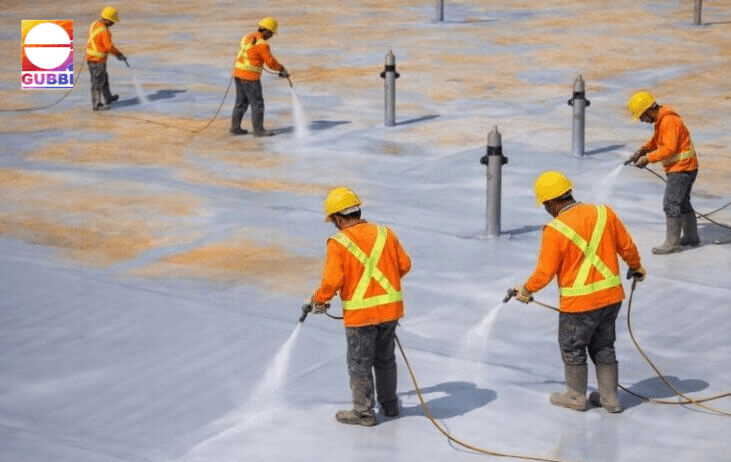
Waterproofing Positive-Side vs Negative-Side: A Technical Perspective for the Built Environment
Water ingress remains one of the most persistent challenges in the lifecycle of buildings and infrastructure. From basements and foundations to podium slabs and retaining walls, uncontrolled moisture penetration can compromise structural integrity, reduce service life, and lead to significant maintenance costs.
Among the various waterproofing strategies used in civil engineering, positive-side and negative-side are two fundamental approaches. While both aim to control water ingress, their principles, performance characteristics, and applications differ significantly. Understanding these differences is essential for engineers, consultants, and project owners to make informed decisions.
Defining Positive-Side and Negative-Side
The distinction between positive-side and negative-side waterproofing is based on the direction of water pressure acting on the structure.
-
- Positive-side waterproofing is applied on the surface directly exposed to water. This is typically the exterior face of a structure, where water first comes into contact.
-
- Negative-side waterproofing is applied on the opposite face — usually the interior — where water has already penetrated or is attempting to pass through the structure.
In simple terms, positive-side systems prevent water from entering the structure, while negative-side systems attempt to manage water that has already reached the structural elements.
Positive-Side Waterproofing: Preventing Water at the Source
This side is generally regarded as the most effective and technically sound approach, particularly for below-grade and water-retaining structures.
Technical Functioning
These systems form a continuous barrier against water and hydrostatic pressure before it reaches the concrete. Common technologies include:
-
- Cementitious waterproof coatings
-
- Bituminous membranes
-
- Elastomeric liquid-applied membranes
-
- Sheet membranes (PVC, HDPE, TPO)
-
- Crystalline waterproofing systems
When properly detailed and installed, positive-side waterproofing resists positive hydrostatic pressure, blocks capillary absorption, and protects reinforcement from exposure to moisture and aggressive chemicals.
Key Advantages
-
- Primary line of defense: Water is stopped before it enters the concrete matrix.
-
- Enhanced durability: Minimizes corrosion of reinforcement and concrete deterioration.
-
- Superior performance under pressure: Suitable for high groundwater conditions.
-
- Long-term reliability: Lower probability of internal dampness, leaks, or mold growth.
Limitations
-
- Requires external access, often involving excavation.
-
- Higher initial cost compared to internal solutions.
-
- Installation demands strict surface preparation and skilled workmanship.
Negative-Side Waterproofing: Managing Water After Entry
This side is commonly used in retrofit or repair scenarios, especially where exterior access is restricted or impractical.
Technical Functioning
These systems resist water pressure from the reverse side or attempt to block water migration within the structure. Typical solutions include:
-
- Cementitious waterproof coatings
-
- Crystalline slurry applications
-
- Injection grouting systems
-
- Internal drainage or pressure relief systems
Negative-side systems must counteract negative hydrostatic pressure, which can be highly demanding on material bond strength and adhesion.
Advantages
-
- Accessible application: No excavation required.
-
- Cost-effective for repairs: Suitable for existing or occupied structures.
-
- Useful for localized leakage control: Especially cracks, joints, or seepage points.
Limitations
-
- Water still contacts the structural element before being controlled.
-
- Does not fully prevent reinforcement corrosion in high moisture environments.
-
- Performance can be compromised under high or fluctuating water pressure.
-
- Often considered a secondary or corrective measure, not a permanent solution.
Comparative Overview
| Parameter | Positive-Side Waterproofing | Negative-Side Waterproofing |
| Water pressure direction | Direct (positive) | Reverse (negative) |
| Application location | Exterior / water-facing side | Interior / dry side |
| Typical usage | New construction, major upgrades | Repairs, retrofits |
| Resistance to hydrostatic pressure | High | Moderate to limited |
| Structural protection | Excellent | Partial |
| Long-term reliability | High | Condition-dependent |
Engineering Factors Influencing System Selection
Selecting the correct waterproofing strategy requires a technical evaluation, not a generic specification. Key considerations include:
1. Groundwater Conditions
High water tables and continuous hydrostatic pressure generally require positive-side solutions.
2. Structural Accessibility
Existing buildings with no exterior access may necessitate negative-side waterproofing.
3. Structural Condition
Cracks, honeycombing, construction joints, and material compatibility must be assessed before system selection.
4. Lifecycle Cost Analysis
While positive-side systems involve higher upfront costs, they typically reduce long-term repair and maintenance expenses.
5. Quality of Execution
Even the most advanced waterproofing system will fail if substrate preparation, detailing, and curing are not executed correctly.
Conclusion
Waterproofing should not be treated as a cosmetic coating or a last-stage activity. It is a core structural protection strategy that directly impacts durability, safety, and asset value.
Positive-side waterproofing remains the preferred engineering solution wherever feasible, while negative-side waterproofing serves as a practical alternative in constrained or remedial situations. The real expertise lies in understanding water behavior, structural interaction, and system limitations — and designing solutions accordingly.
In an era where infrastructure longevity and sustainability are paramount, technically informed waterproofing decisions make the difference between recurring problems and lasting performance.