Structural Jacketing Services
Jacketing Services for Structural Strengthening in India
Structural jacketing is a scientific and proven structural strengthening technique used to enhance the load-carrying capacity, ductility, durability, and seismic performance of existing RCC (Reinforced Cement Concrete) members. The selection of the appropriate jacketing method depends on the condition of the structure, site constraints, load requirements, execution feasibility, and long-term durability needs. Structural jacketing constitutes a scientifically validated and established structural retrofitting methodology deployed to augment the axial, flexural, and shear load-bearing capacity, hysteretic performance (ductility), service life (durability), and seismic resilience of existing Reinforced Cement Concrete (RCC) structural elements. The judicious selection of the appropriate jacketing system is contingent upon a comprehensive analysis of the current structural integrity, logistical constraints of the construction site, requisite design load augmentation, feasibility of execution, and long-term serviceability requirements.
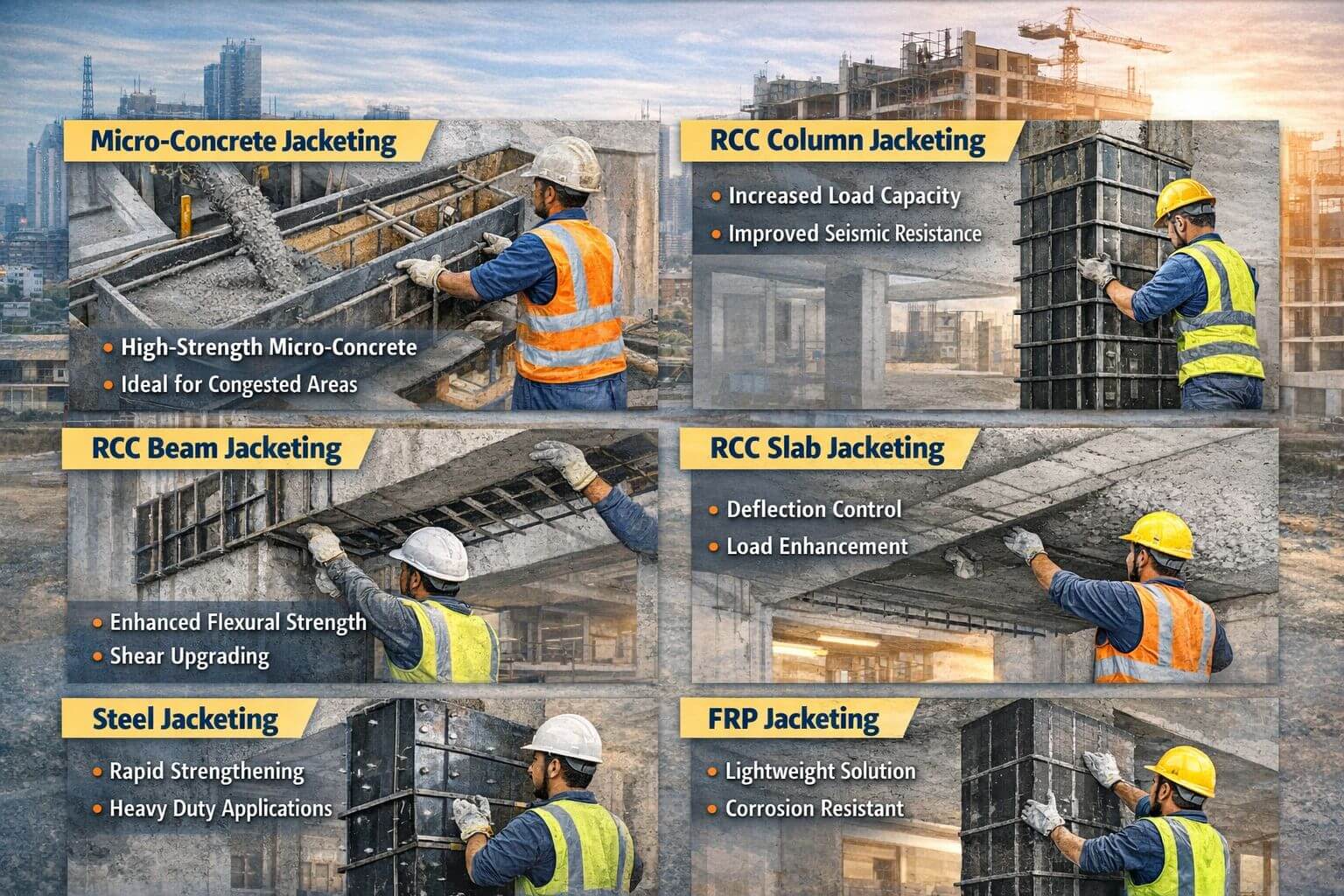
Type of jacketing services offered by Gubbi Civil Engineers.
1. Micro-Concrete Jacketing Services
Micro-Concrete Jacketing is an advanced form of RCC jacketing in which pre-packed, non-shrink, high-strength micro-concrete is used instead of conventional site-mixed concrete. This method is especially suitable for congested reinforcement zones and precision structural repairs.
How Micro-Concrete Jacketing Works?
- Deteriorated and loose concrete is carefully removed
- Existing reinforcement is exposed, cleaned, and treated with anti-corrosion coating
- Additional reinforcement and shear connectors are fixed as per design
- Formwork is installed around the member
- Micro-concrete is poured or pumped into the formwork
- The material flows uniformly around the reinforcement without vibration
Why Micro-Concrete Is Preferred?
- Conventional concrete cannot flow effectively in congested sections
- Micro-concrete ensures complete encapsulation of reinforcement
- Eliminates honeycombing, voids, and segregation
- Ensures uniform strength and superior bonding
Structural Benefits
- Increases axial, flexural, and shear capacity
- Improves stiffness and ductility
- Enhances long-term durability
- Provides excellent bond with existing concrete
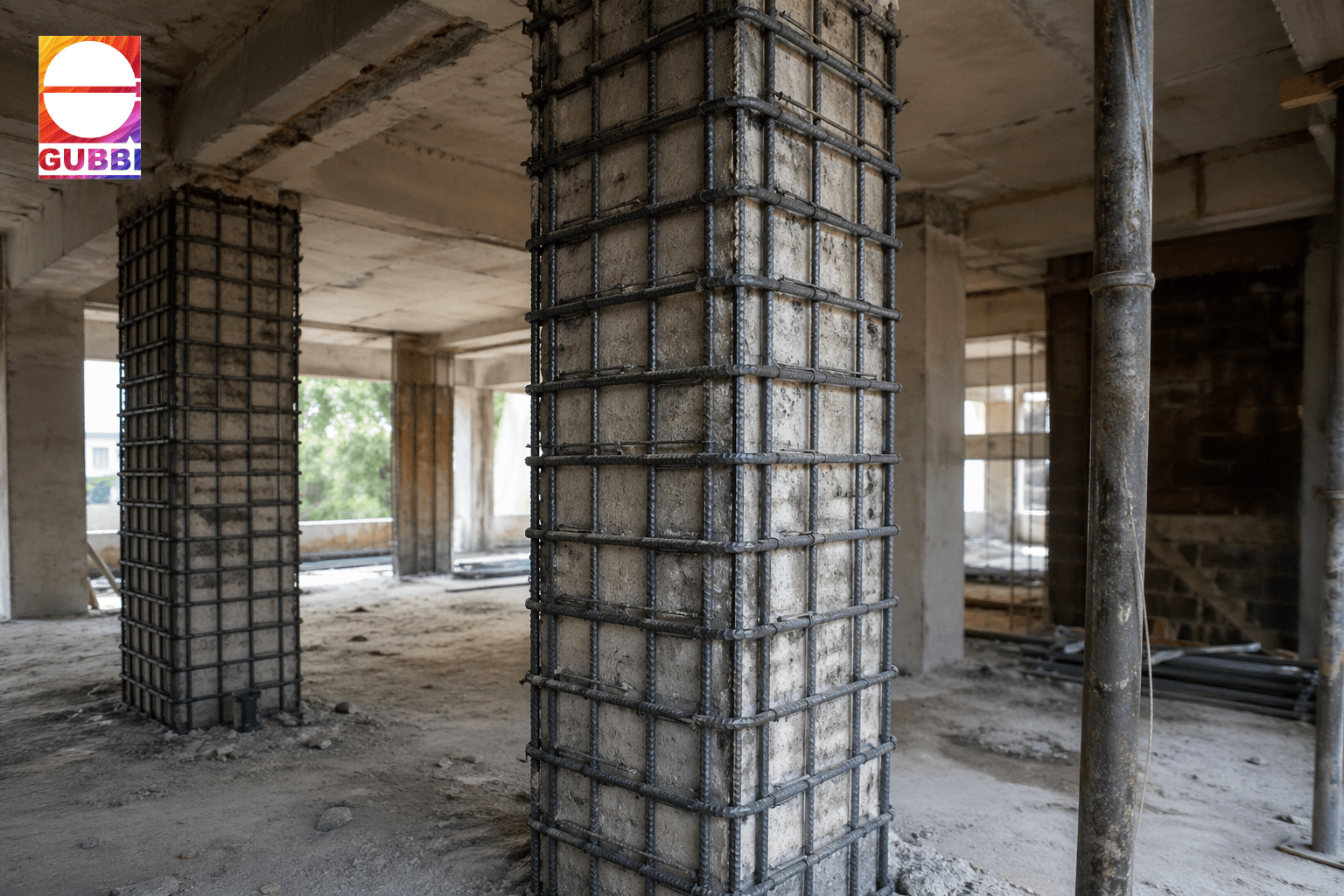
2. RCC Column Jacketing Services
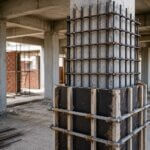
RCC Column Jacketing involves increasing the effective cross-section of existing columns using additional reinforcement and concrete or micro-concrete to restore and enhance structural capacity.
Purpose of RCC Column Jacketing
- Restore strength lost due to corrosion or deterioration
- Increase axial load-carrying capacity
- Improve earthquake resistance and ductility
- Strengthen columns for additional floors or increased loads
RCC Column Jacketing Execution Process
- Structural assessment and load evaluation
- Removal of damaged and loose concrete
- Cleaning and treatment of existing reinforcement
- Fixing of additional vertical bars and lateral ties
- Placement of concrete or micro-concrete
- Controlled curing to achieve design strength
Structural Improvements Achieved
- Higher axial and moment capacity
- Improved confinement and ductility
- Reduced risk of brittle column failure
- Enhanced seismic performance
3. RCC Beam Jacketing Services
RCC Beam Jacketing is adopted to strengthen beams that are deficient in flexural strength, shear capacity, or stiffness due to overloading, aging, or design inadequacy.
Why Beam Jacketing Is Required?
- Structural cracks caused by overloading
- Excessive deflection
- Inadequate original reinforcement
- Change in building usage or load pattern
Beam Jacketing Method
- Removal of damaged concrete
- Installation of additional longitudinal reinforcement and stirrups
- Anchoring of new reinforcement into the existing beam
- Encasing the beam with concrete or micro-concrete
Benefits Of RCC Beam Jacketing
- Restores beam strength and stiffness
- Improves shear resistance
- Prevents progressive structural failure
- Enhances overall load distribution
4. RCC Slab Jacketing Services
RCC Slab Jacketing is used to strengthen slabs that have lost load-carrying capacity due to aging, corrosion, excessive deflection, or change in usage.
When Slab Jacketing Is Needed?
- Excessive sagging or deflection
- Structural or shrinkage cracks
- Change of usage (office to storage, machinery installation)
- Fire or environmental damage
Slab Jacketing Technique
- Surface preparation and crack treatment
- Installation of additional reinforcement mesh
- Application of concrete or micro-concrete overlay
- Proper curing and surface finishing
Structural Outcomes
- Increased load-bearing capacity
- Reduced deflection
- Improved serviceability and durability
- Enhanced safety under static and dynamic loads
5. Steel Jacketing/Steel Splicing
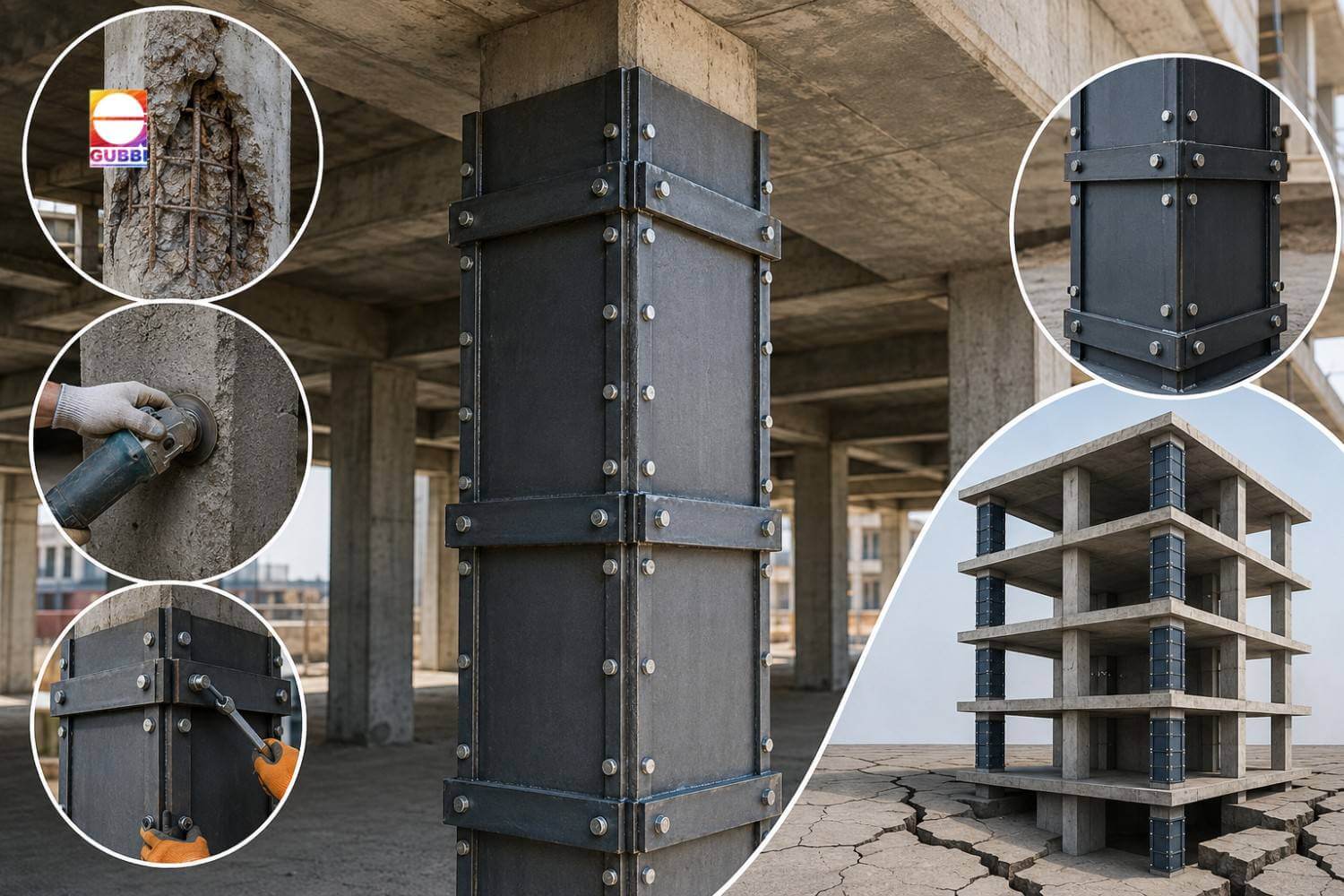
Steel Splicing/Steel Jacketing involves strengthening RCC members using steel plates, angles, or sections fixed mechanically or chemically to form a composite structural system.
Why Steel Splicing Is Used?
- Requirement for rapid strengthening
- Minimal increase in member size
- Industrial environments with heavy loads or vibrations
Steel Splicing Execution Method
- Steel plates or sections are fixed around columns or beams
- Anchors, bolts, or welding ensure composite action
- Protective coatings are applied for corrosion resistance
Steel Splicing Advantages
- Immediate strength enhancement
- No curing time required
- Suitable for high-load and vibration-prone structures
Limitations
- Requires corrosion protection
- Fire protection measures may be necessary
Frequently Asked Questions
Which is the best structural jacketing method for old buildings?
The best structural jacketing method depends on the building condition and load requirements. RCC jacketing is commonly preferred for heavy strengthening, while FRP wrapping and steel jacketing are ideal for fast-track retrofitting and seismic upgrades.
Can structural jacketing repair cracked columns and beams?
Yes, structural jacketing is widely used to repair cracked RCC columns, beams, slabs, and structural members. It helps restore strength, improve durability, and prevent further structural deterioration.
Is structural jacketing suitable for earthquake-prone areas?
Yes, structural jacketing is highly effective for seismic retrofitting because it improves ductility, confinement, and lateral load resistance in earthquake-prone structures.
When is structural retrofitting necessary?
Retrofitting becomes crucial when a structure is showing signs of distress, no longer compliant with safety regulations, or requires increasing the load carrying capacity, such as transforming an office into a hospital or data centre
What is the best solution for strengthening old RCC structures?
Structural retrofitting and RCC jacketing are among the most reliable solutions for strengthening old RCC buildings affected by cracks, deterioration, corrosion, or increased load demands.