
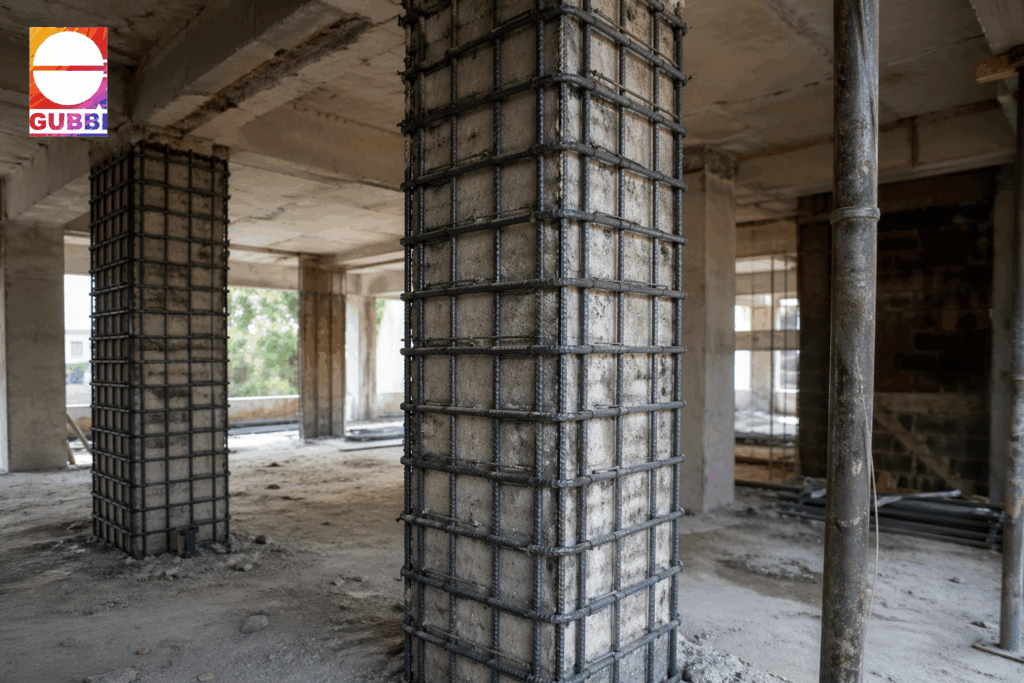
Structural deterioration in buildings is not always visible at early stages, but delayed intervention can lead to serious safety risks. Column jacketing is one of the most effective structural retrofitting techniques used to restore and enhance the load-carrying capacity of reinforced concrete (RCC) columns.
Understanding the exact conditions when a building requires column jacketing is critical for ensuring structural safety, durability, and compliance with modern design standards.
What is Column Jacketing?
Column Jacketing is a structural strengthening method in which additional concrete, steel reinforcement, or fiber-reinforced polymers are added around an existing column to improve its strength, stiffness, and load-bearing capacity.
This technique is widely used in building rehabilitation and seismic retrofitting projects.
When Does a Building Need Column Jacketing?
1. Reduction in Load Carrying Capacity
When an existing structure undergoes a change in usage, such as converting residential buildings into commercial spaces, the load demand increases significantly.
If the existing columns are not designed for the increased loads, column jacketing becomes necessary to enhance their capacity.
2. Structural Damage or Cracking in Columns
Visible cracks, spalling of concrete, or exposed reinforcement indicate structural distress.
Common causes include:
Overloading
Poor construction quality
Corrosion of reinforcement
Column jacketing helps restore the original strength and prevents further deterioration.
3. Corrosion of Reinforcement Steel
Exposure to moisture, chemicals, or aggressive environmental conditions leads to corrosion of steel reinforcement.
Corrosion reduces the effective cross-section of steel and weakens the column.
Jacketing provides additional protection and restores structural integrity.
4. Seismic Retrofitting Requirements
Buildings located in seismic zones often require strengthening to withstand earthquake forces.
Older buildings not designed as per current seismic codes are highly vulnerable.
Column jacketing improves ductility and energy absorption capacity, making the structure safer during earthquakes.
5. Design or Construction Deficiencies
Errors in design calculations or poor execution during construction can lead to insufficient reinforcement or inadequate column dimensions.
Such deficiencies may not be immediately visible but can compromise long-term safety.
Jacketing corrects these deficiencies effectively.
6. Foundation Settlement Issues
Uneven settlement of foundations can induce additional stresses in columns.
Symptoms include:
Diagonal cracks
Tilting of columns
Structural misalignment
Column jacketing helps redistribute loads and stabilize the structure.
7. Fire Damage to Structural Members
Exposure to high temperatures during fire incidents reduces the strength of concrete and steel.
Post-fire assessment often reveals weakened columns.
Jacketing restores the lost strength and ensures continued usability of the structure.
8. Aging and Material Degradation
Over time, construction materials deteriorate due to environmental exposure, carbonation, and wear.
Older buildings typically require retrofitting to meet current safety standards.
Column jacketing extends the service life of such structures.
Signs That Indicate Immediate Need for Column Jacketing
Wide or deep cracks in columns
Concrete spalling or falling off
Rust stains on column surfaces
Visible bending or deformation
Increase in structural deflection
Sudden change in building usage/load
Ignoring these signs can lead to severe structural failure.
Types of Column Jacketing Methods
Column Jacketing is not a single fixed method. The technique is selected based on the damage level, load demand, site conditions, and structural safety requirements. Below are the main types used in structural strengthening projects:
1. RCC Jacketing (Reinforced Concrete Jacketing)
RCC Column Jacketing is the most widely used and traditional strengthening method.
How it works:
Existing column is roughened and cleaned
Additional steel reinforcement is added around the column
Formwork is placed and fresh concrete is poured
Why it is used:
To significantly increase load-bearing capacity
To repair severely damaged or weak columns
To improve seismic resistance
Best suited for:
Old RCC buildings, overloaded columns, and structural rehabilitation projects
2. Steel Jacketing
Steel Jacketing involves encasing the column with steel plates or sections.
How it works:
Steel plates or angles are fixed around the column
Gaps are filled with grout or epoxy
Provides confinement to the existing column
Why it is used:
Quick installation
High strength gain with minimal size increase
Useful in space-constrained areas
Best suited for:
Industrial structures, bridge columns, and fast-track strengthening work
3. FRP Column Jacketing (Carbon/Glass Fiber Wrapping)
FRP Jacketing (Fiber Reinforced Polymer) wrapping is a modern, high-performance strengthening method.
How it works:
Column surface is cleaned and prepared
Epoxy resin is applied
Carbon or glass fiber sheets are wrapped around the column
Why it is used:
High strength-to-weight ratio
Corrosion resistant
Minimal increase in column size
Fast execution
Best suited for:
Earthquake strengthening, retrofitting, and buildings where space is limited
4. Ferrocement Jacketing
Ferrocement jacketing uses thin wire mesh and rich cement mortar.
How it works:
Wire mesh is wrapped around the column
Mortar is applied in layers
Provides composite strengthening
Why it is used:
Economical solution
Improves durability and crack resistance
Easy application in small projects
Best suited for:
Minor structural repairs, low-cost strengthening, and residential buildings
Advantages of Column Jacketing
Increased load carrying capacity
Improved structural stability
Enhanced seismic resistance
Cost-effective compared to reconstruction
Extended building lifespan
Minimal disruption during execution
Why Timely Column Jacketing is Critical?
Delaying structural strengthening can cause minor column damage to progress into severe structural failure, increasing both risk and repair cost. Early intervention with Column Jacketing ensures long-term safety, stability, and performance of RCC structures.
Key Importance of Timely Column Jacketing:
Ensures safety of occupants and building structure
Maintains compliance with structural engineering standards
Prevents progressive deterioration of RCC columns
Reduces future repair and rehabilitation costs
Extends the service life and durability of the structure
Conclusion
Column jacketing is not just a structural repair technique; it is a critical structural intervention that ensures safety, performance, and longevity of buildings.
Any sign of distress, increased load demand, or aging should be evaluated by structural experts to determine the need for jacketing.
For reliable and technically sound retrofitting solutions, professional assessment and execution are essential.
Gubbi Civil Engineers specializes in advanced structural strengthening techniques including column jacketing, carbon fiber wrapping, shotcreting, and complete building rehabilitation solutions.
With a focus on quality, safety, and engineering excellence, the team ensures durable and cost-effective retrofitting for all types of structures.
FAQs
1. How do I know if my building needs column jacketing?
If you notice cracks, corrosion, reduced load capacity, or structural damage, a structural audit can confirm the need for jacketing.
2. Is column jacketing expensive?
It is more cost-effective than demolition and reconstruction, especially for structurally repairable buildings.
3. How long does column jacketing last?
With proper design and execution, it significantly extends the building life by several decades.
4. Can column jacketing be done in occupied buildings?
Yes, it is usually performed with minimal disruption to occupants.