
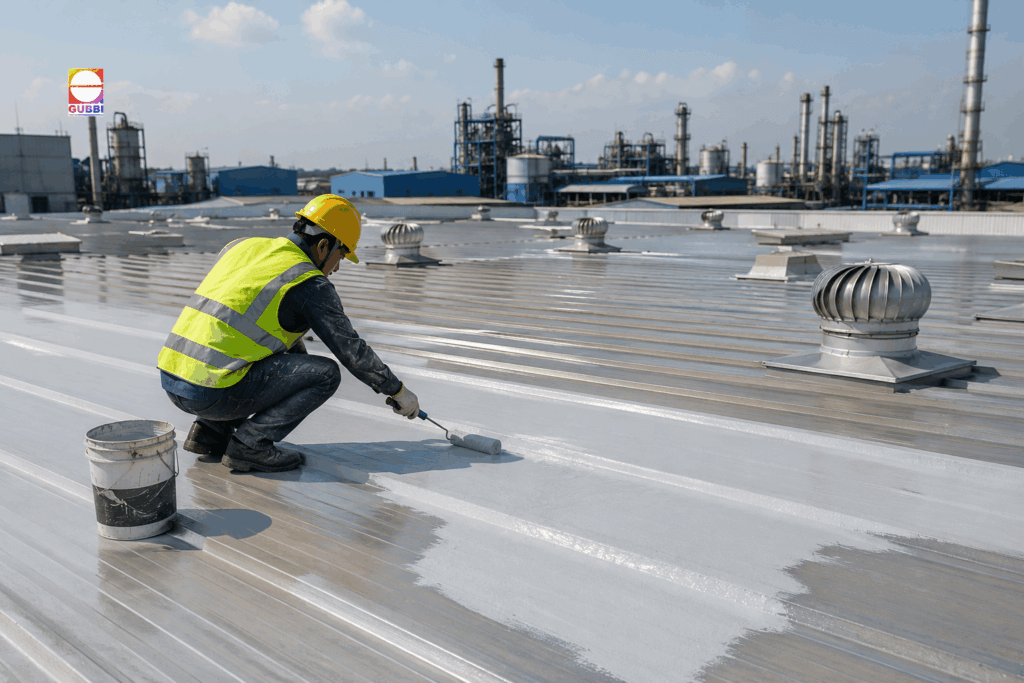
Roof Waterproofing Services play a critical role in protecting the long-term durability of reinforced concrete (RCC) structures by preventing one of the most destructive causes of structural deterioration water ingress. While roof leakage is often treated as a routine maintenance issue, its impact extends far beyond visible dampness. Moisture penetrating through an inadequately protected roof can initiate reinforcement corrosion, accelerate concrete deterioration, weaken protective finishes, and gradually reduce the service life of a building. By creating an effective barrier against water infiltration, professionally designed roof waterproofing systems help preserve structural integrity, minimize future repair costs, and enhance the overall lifecycle performance of industrial, commercial, and residential buildings.
For industrial facilities, commercial buildings, warehouses, institutions, and residential developments, Roof Waterproofing Solutions are an essential component of long-term structural protection. A professionally designed waterproofing system not only prevents water ingress but also preserves structural durability, reduces lifecycle maintenance costs, and minimizes the need for future rehabilitations.
Why Roof Waterproofing Is Critical for Structural Durability?
The roof is the building’s first barrier against environmental exposure. Throughout its service life, it experiences rainfall, ultraviolet radiation, thermal expansion and contraction, wind-driven moisture, and standing water. When waterproofing systems deteriorate or are improperly installed, water begins entering the concrete through surface cracks, construction joints, expansion joints, service penetrations, and porous concrete.
Unlike visible leakage, moisture penetration inside the concrete remains unnoticed for extended periods. During this time, deterioration continues beneath the surface, eventually leading to costly structural repairs.
Timely Roof Waterproofing prevents moisture from entering the structural system and significantly improves the long-term durability of reinforced concrete.
How Water Ingress Affects Reinforced Concrete Structures?
Concrete is naturally porous. Even high-quality concrete allows limited moisture movement through microscopic capillaries. When the protective waterproofing layer fails, continuous exposure to water accelerates several deterioration mechanisms.
The most critical is reinforcement corrosion.
Steel reinforcement remains protected because fresh concrete provides an alkaline environment that forms a passive protective layer around the steel. Continuous moisture penetration, combined with carbonation or chloride contamination, gradually destroys this protection.
Once corrosion begins, the expanding rust exerts pressure on the surrounding concrete, causing:
- Cracking of concrete cover
- Delamination of concrete layers
- Concrete spalling
- Reduction in reinforcement diameter
- Loss of bond between steel and concrete
- Reduced structural durability
These defects often remain hidden until visible damage appears, making preventive waterproofing significantly more economical than structural repair.
Roof Waterproofing Protects More Than Just the Roof
A properly engineered waterproofing system safeguards multiple components of a building simultaneously.
It helps protect:
- Reinforced concrete roof slabs
- Structural beams and supporting members
- Electrical systems
- Mechanical equipment
- Interior finishes
- Insulation materials
- Warehoused products and machinery
- Occupant comfort and indoor environment
For industrial facilities, preventing water ingress also minimizes operational downtime and maintenance interruptions.
Engineering Assessment Before Roof Waterproofing
Effective waterproofing starts with understanding the condition of the structure not simply selecting a waterproofing product.
Professional Waterproofing Services include a detailed technical assessment covering:
- Existing roof slab condition
- Structural cracks and dormant cracks
- Concrete deterioration
- Ponding water locations
- Drainage efficiency
- Expansion joints
- Construction joints
- Previous waterproofing failures
- Surface preparation requirements
This engineering assessment helps identify the actual source of water ingress and determines the best waterproofing solutions for the structure.
Choosing the Right Roof Waterproofing System
Every building has different exposure conditions, structural movement, and service requirements. Therefore, there is no universal waterproofing system suitable for every roof.
Depending on project requirements, engineers may recommend:
- Polyurethane waterproofing systems for flexible crack-bridging performance
- Liquid-applied waterproofing membranes for seamless protection
- Cementitious waterproofing systems for compatible concrete substrates
- Elastomeric coatings for UV resistance and thermal movement
- Bituminous membrane systems for large roof areas
- Crystalline waterproofing for internal concrete protection
The selection should always consider structural movement, weather exposure, expected service life, maintenance requirements, and compatibility with the existing substrate.
Why Installation Quality Determines Waterproofing Performance?
Even the highest-quality waterproofing materials can fail if installation practices are inadequate.
Successful waterproofing depends on:
- Proper surface preparation
- Removal of loose concrete and contaminants
- Crack repair before waterproofing
- Moisture-controlled substrate conditions
- Correct primer application
- Uniform membrane thickness
- Proper detailing at parapets, joints, drains, and penetrations
- Quality control during execution
Attention to these details significantly increases waterproofing durability and minimizes premature failures.
Roof Waterproofing as Part of Structural Rehabilitation
Buildings undergoing structural repair should never treat waterproofing as an independent activity.
Where rehabilitation includes:
- RCC repair
- Concrete restoration
- Crack injection
- Structural strengthening
- Roof slab rehabilitation
Roof waterproofing should be integrated into the overall repair strategy.
Without eliminating moisture ingress, repaired concrete remains vulnerable to future deterioration, reducing the effectiveness of rehabilitation work.
Long-Term Benefits of Professional Roof Waterproofing Services
Investing in preventive waterproofing delivers measurable engineering and financial benefits throughout the structure’s lifecycle.
These include:
- Extended structural service life
- Reduced reinforcement corrosion
- Lower maintenance costs
- Improved concrete durability
- Protection against recurring leakage
- Better asset lifecycle performance
- Reduced future repair expenditure
- Improved building reliability
For industrial and commercial buildings, these benefits directly contribute to operational continuity and long-term asset value.
Conclusion
Roof waterproofing is much more than a solution for stopping roof leaks. It is a preventive engineering measure that protects reinforced concrete structures from one of their most significant causes of deterioration, water ingress.
Professionally executed Roof Waterproofing Services preserve structural durability by preventing moisture penetration, reducing reinforcement corrosion, improving concrete performance, and extending the service life of buildings. Combined with regular inspections, timely maintenance, and appropriate material selection, roof waterproofing becomes a strategic investment in the long-term performance of any structure rather than an avoidable maintenance expense.
Why are Roof Waterproofing Services important for RCC structures?
Roof Waterproofing Services prevent water from penetrating concrete roof slabs, reducing the risk of reinforcement corrosion, concrete deterioration, leakage, and costly structural repairs.
Can roof leakage affect structural strength?
Yes. Continuous water ingress accelerates reinforcement corrosion and concrete damage. If left untreated, these defects can reduce the durability and long-term performance of structural members.
When should a roof be waterproofed?
Waterproofing is recommended during new construction, after major roof repairs, before monsoon seasons, or whenever signs of leakage, ponding water, or waterproofing deterioration are observed.
Which waterproofing system is best for concrete roofs?
The most suitable system depends on factors such as roof condition, exposure, structural movement, drainage, and expected service life. A professional engineering assessment is essential before selecting the waterproofing solution.
Does waterproofing eliminate future maintenance?
No. While high-quality waterproofing significantly reduces maintenance requirements, periodic inspections and preventive maintenance help maximize the service life of the waterproofing system.
Protect Your Structure Before Water Causes Costly Damage
Waterproofing should never begin only after visible leakage appears. Early intervention helps preserve structural durability, reduce repair costs, and extend the life of your building.
At Gubbi Civil Engineers, we provide engineering-driven Roof Waterproofing Services backed by detailed condition assessment, appropriate system selection, and quality-controlled execution for industrial, commercial, institutional, and infrastructure projects.