
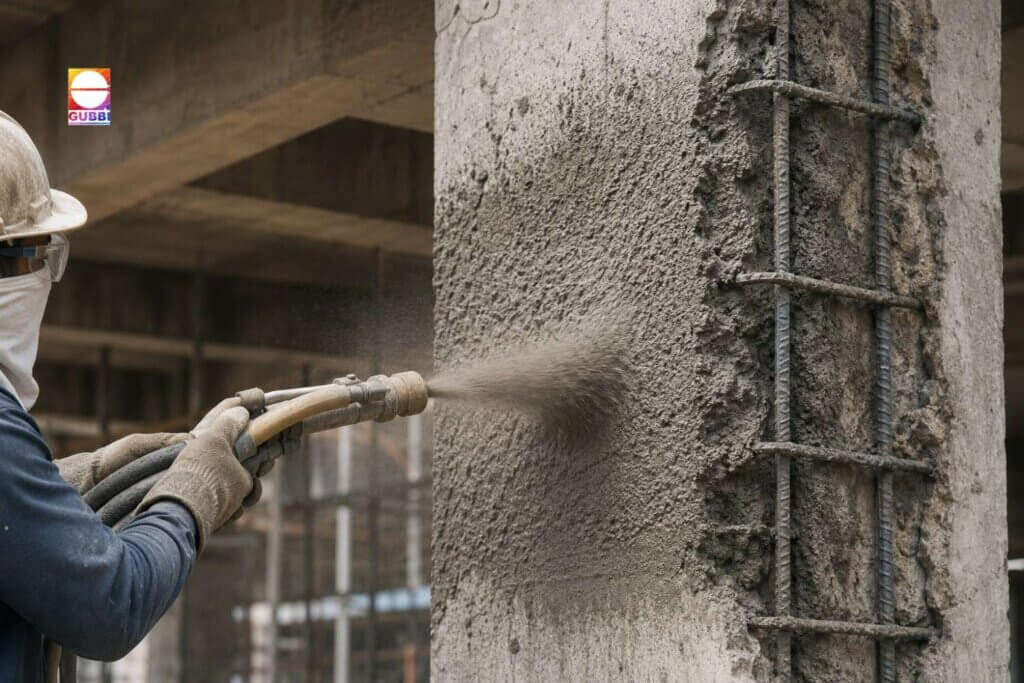
Weak concrete structures are a common issue in aging buildings, industrial facilities, bridges, water tanks, and RCC elements exposed to years of stress and environmental damage. Often, the visible signs begin with cracks, concrete chipping, rust stains, or surface deterioration. However, the real issue usually lies deeper, reduced concrete density, reinforcement corrosion, and weakened bonding within the structural member.
This is where guniting becomes a highly effective structural rehabilitation technique.
Unlike ordinary patch repairs, guniting services do not simply cover damaged surfaces. The process technically improves the structural surface by creating a dense, compact, and strongly bonded concrete layer that integrates with the existing substrate.
To understand why engineers recommend guniting for weakened RCC structures, it is important to understand what actually happens inside damaged concrete.
Why Weak Concrete Loses Strength Over Time?
Concrete deterioration usually happens because the internal protective system of RCC starts failing.
Concrete naturally protects steel reinforcement through alkalinity. But over time, factors such as:
- Water ingress
- Chloride attack
- Carbonation
- Poor compaction during construction
- Honeycombing
- Repeated structural stress
reduce the protective quality of concrete.
Once moisture reaches reinforcement bars, corrosion begins. Steel expands during rusting, which creates internal pressure. This pressure causes:
- Cracks in concrete
- Surface spalling
- Separation between steel and concrete
- Reduction in structural stiffness
At this stage, ordinary plastering or cosmetic repair becomes ineffective because the issue is structural rather than superficial.
This is why experienced guniting contractors recommend structural rehabilitation instead of temporary surface repairs.
How Guniting Strengthens Concrete?
The strengthening effect of guniting comes from three engineering principles:
1. High-Velocity Material Compaction
In normal repair methods, concrete or mortar is manually applied, leaving chances for air voids and weak bonding.
In guniting, cement mortar or concrete is pneumatically sprayed at very high velocity onto the prepared surface.
This force creates:
- Better material compaction
- Reduced porosity
- Higher surface density
- Stronger interlocking with old concrete
Technically, this results in a denser repair layer with lower permeability compared to conventional repair mortar.
Lower permeability means reduced water penetration which slows future deterioration.
2. Improved Mechanical Bond With Existing RCC
One major challenge in concrete rehabilitation is creating a strong interface between old and new material.
When repairs are manually patched, weak adhesion often causes debonding after a few years.
Professional guniting work contractors prepare the substrate by roughening damaged concrete surfaces before spraying material.
The high-pressure impact of guniting mortar allows:
Mechanical Interlocking
The sprayed particles penetrate micro-irregularities in the old concrete.
Surface Consolidation
Loose and porous areas become more stable.
Monolithic Action
The repaired layer behaves closer to the original RCC member instead of acting as a separate patch.
This significantly improves repair durability.
3. Section Restoration of Damaged Structural Members
Weak structures often suffer from concrete loss due to spalling.
For example:
When corrosion damages a column, concrete around reinforcement starts breaking off, reducing the effective cross-sectional area.
This affects:
- Compression capacity
- Structural stability
- Load distribution
Guniting services restore the lost concrete profile by rebuilding damaged sections using high-strength mortar.
Technically, this helps restore:
Original Structural Geometry
The RCC member regains proper dimensions.
Load Resistance
Stress transfer improves after rehabilitation.
Reinforcement Protection
Steel bars receive a fresh protective concrete cover.
This is particularly important in columns, beams, and slabs.
Why Guniting Performs Better Than Conventional Repair?
Many property owners assume plastering or patch filling solves structural damage.
In reality, traditional repairs often fail because:
- They lack density
- Shrinkage cracks develop
- Bond strength remains weak
- Repairs separate from the substrate
Guniting contractors prefer sprayed application because the impact energy naturally compacts material against the surface.
This reduces rebound voids and improves long-term performance.
As a result, the repaired member becomes structurally more stable rather than visually repaired only.
Structural Situations Where Guniting Is Most Effective?
Engineers commonly recommend guniting when structures show:
Honeycombed Concrete
Poor compaction during casting creates voids inside RCC.
Concrete Spalling
Concrete breaks away due to reinforcement corrosion.
Beam and Column Damage
Structural elements lose section thickness.
Seepage-Induced Damage
Continuous moisture weakens concrete over time.
Aging RCC Structures
Buildings over decades old often require strengthening interventions.
In such cases, guniting services help improve durability without complete demolition.
Why Surface Preparation Determines Guniting Success?
One overlooked technical factor is surface preparation.
Even the best guniting material can fail if weak concrete remains underneath.
Professional guniting contractors focus heavily on:
- Removing unsound concrete
- Exposing damaged reinforcement
- Cleaning corrosion products
- Creating proper surface roughness
- Ensuring moisture control before application
This creates the ideal bonding condition for long-term performance.
Poor preparation is often the main reason failed repairs occur.
How Guniting Extends Structural Life?
From an engineering perspective, guniting slows structural deterioration by improving the protective barrier around reinforcement.
A properly rehabilitated member experiences:
- Reduced moisture penetration
- Better concrete density
- Improved reinforcement protection
- Enhanced crack resistance
- Better durability under environmental stress
This can significantly extend the service life of weakened structures without requiring expensive reconstruction.
Conclusion
Weak concrete structures usually fail because of internal deterioration, not just visible cracks. This is why surface-level repairs often provide only temporary relief.
Guniting strengthens weak concrete structures by improving density, restoring damaged sections, increasing bond strength, and protecting reinforcement from further deterioration.
When performed correctly by experienced guniting contractors, the repair becomes part of the structural system itself rather than just a surface treatment.
For aging RCC buildings, industrial facilities, water tanks, and structurally distressed members, professional guniting services remain one of the most technically reliable rehabilitation methods available.