
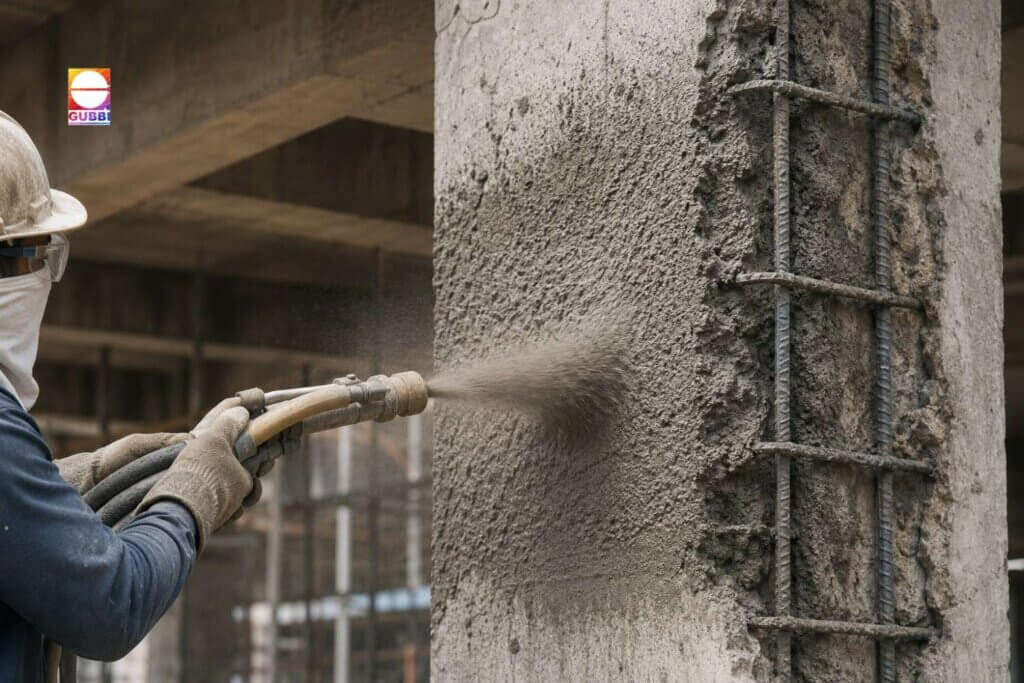
Guniting is one of the most effective concrete strengthening and structural rehabilitation techniques used to restore weak, damaged, and deteriorated RCC structures. Widely adopted in buildings, industrial facilities, bridges, water tanks, retaining walls, and infrastructure projects, guniting helps improve structural integrity, enhance durability, and extend the service life of aging concrete assets.
Many concrete structures develop cracks, spalling, reinforcement corrosion, and surface deterioration after years of exposure to environmental conditions, moisture ingress, operational loads, and aging. While these defects may appear minor on the surface, the actual problem often lies deeper within the concrete, where reduced density, weakened bonding, and corrosion-related damage gradually compromise structural performance.
Unlike conventional patch repairs that primarily address visible defects, professional guniting services provide a comprehensive rehabilitation solution. By pneumatically applying a dense, high-strength mortar layer at high velocity, guniting creates superior compaction, excellent bond strength, and long-lasting protection against further deterioration.
To understand why engineers and structural consultants frequently recommend guniting for weak concrete structures, it is important to examine the underlying causes of concrete deterioration and how guniting restores structural strength from the surface inward.
Why Weak Concrete Loses Strength Over Time?
Concrete deterioration usually happens because the internal protective system of RCC starts failing.
Concrete naturally protects steel reinforcement through alkalinity. But over time, factors such as:
- Water ingress
- Chloride attack
- Carbonation
- Poor compaction during construction
- Honeycombing
- Repeated structural stress
reduce the protective quality of concrete.
Once moisture reaches reinforcement bars, corrosion begins. Steel expands during rusting, which creates internal pressure. This pressure causes:
- Cracks in concrete
- Surface spalling
- Separation between steel and concrete
- Reduction in structural stiffness
At this stage, ordinary plastering or cosmetic repair becomes ineffective because the issue is structural rather than superficial.
This is why experienced guniting contractors recommend structural rehabilitation instead of temporary surface repairs.
How Guniting Strengthens Concrete?
The strengthening effect of guniting comes from three engineering principles:
1. High-Velocity Material Compaction
In normal repair methods, concrete or mortar is manually applied, leaving chances for air voids and weak bonding.
In guniting, cement mortar or concrete is pneumatically sprayed at very high velocity onto the prepared surface.
This force creates:
- Better material compaction
- Reduced porosity
- Higher surface density
- Stronger interlocking with old concrete
Technically, this results in a denser repair layer with lower permeability compared to conventional repair mortar.
Lower permeability means reduced water penetration which slows future deterioration.
2. Improved Mechanical Bond With Existing RCC
One major challenge in concrete rehabilitation is creating a strong interface between old and new material.
When repairs are manually patched, weak adhesion often causes debonding after a few years.
Professional guniting work contractors prepare the substrate by roughening damaged concrete surfaces before spraying material.
The high-pressure impact of guniting mortar allows:
Mechanical Interlocking
The sprayed particles penetrate micro-irregularities in the old concrete.
Surface Consolidation
Loose and porous areas become more stable.
Monolithic Action
The repaired layer behaves closer to the original RCC member instead of acting as a separate patch.
This significantly improves repair durability.
3. Section Restoration of Damaged Structural Members
Weak structures often suffer from concrete loss due to spalling.
For example:
When corrosion damages a column, concrete around reinforcement starts breaking off, reducing the effective cross-sectional area.
This affects:
- Compression capacity
- Structural stability
- Load distribution
Guniting services restore the lost concrete profile by rebuilding damaged sections using high-strength mortar.
Technically, this helps restore:
Original Structural Geometry
The RCC member regains proper dimensions.
Load Resistance
Stress transfer improves after rehabilitation.
Reinforcement Protection
Steel bars receive a fresh protective concrete cover.
This is particularly important in columns, beams, and slabs.
Why Guniting Performs Better Than Conventional Repair?
Many property owners assume plastering or patch filling solves structural damage.
In reality, traditional repairs often fail because:
- They lack density
- Shrinkage cracks develop
- Bond strength remains weak
- Repairs separate from the substrate
Guniting contractors prefer sprayed application because the impact energy naturally compacts material against the surface.
This reduces rebound voids and improves long-term performance.
As a result, the repaired member becomes structurally more stable rather than visually repaired only.
Structural Situations Where Guniting Is Most Effective?
Engineers commonly recommend guniting when structures show:
Honeycombed Concrete
Poor compaction during casting creates voids inside RCC.
Concrete Spalling
Concrete breaks away due to reinforcement corrosion.
Beam and Column Damage
Structural elements lose section thickness.
Seepage-Induced Damage
Continuous moisture weakens concrete over time.
Aging RCC Structures
Buildings over decades old often require strengthening interventions.
In such cases, guniting services help improve durability without complete demolition.
Why Surface Preparation Determines Guniting Success?
Surface preparation is one of the most important factors affecting the success of any guniting project. Even high-quality guniting materials can fail if they are applied over weak, contaminated, or deteriorated concrete. A strong bond between the existing concrete and the new guniting layer is essential for achieving long-term durability and structural performance.
Professional guniting contractors focus on thorough substrate preparation by:
- Removing all unsound, loose, cracked, and deteriorated concrete
- Exposing corroded or damaged reinforcement bars for inspection and treatment
- Cleaning rust, corrosion products, laitance, oil, grease, and contaminants from the repair area
- Restoring or replacing severely damaged reinforcement where required
- Creating an adequately roughened surface profile to improve mechanical interlock and bond strength
- Eliminating dust and loose particles through air blowing or water cleaning
- Ensuring proper surface moisture conditions before guniting application
- Verifying substrate integrity to support the new repair layer
Proper preparation allows the guniting material to bond effectively with the existing structure, reducing the risk of debonding, cracking, and premature repair failure. In many cases, poor surface preparation is the primary reason concrete repair projects fail, making it a critical step for long-lasting rehabilitation results.
How Guniting Extends Structural Life?
Guniting plays a vital role in extending the service life of deteriorated concrete structures. The process not only repairs damaged concrete but also restores the protective cover around reinforcement, which is essential for preventing further corrosion and structural degradation.
When concrete becomes cracked, porous, or spalled, harmful substances such as moisture, chlorides, sulphates, carbon dioxide, and industrial contaminants can easily penetrate the structure. These aggressive agents accelerate reinforcement corrosion, reduce concrete durability, and weaken the overall load-carrying capacity of the member. Guniting addresses these issues by applying a dense, high-strength mortar or concrete layer that forms a strong bond with the existing substrate.
A professionally executed guniting system helps structures achieve:
- Reduced moisture and water ingress through improved surface impermeability
- Higher concrete density with fewer voids and reduced permeability
- Enhanced protection of reinforcement against corrosion and environmental exposure
- Improved resistance to shrinkage, thermal, and structural cracking
- Greater durability under aggressive environmental and industrial conditions
- Improved resistance to weathering, carbonation, and chemical attack
- Restoration of concrete cover thickness around exposed reinforcement
- Increased long-term structural stability and performance
Because the material is pneumatically applied at high velocity, it achieves superior compaction and excellent adhesion compared to many conventional repair methods. This creates a durable repair layer capable of withstanding mechanical stresses and environmental challenges over extended periods.
As a result, guniting significantly slows the rate of structural deterioration, minimizes future maintenance requirements, and helps asset owners avoid premature replacement or costly reconstruction. For buildings, bridges, water-retaining structures, industrial facilities, and RCC components affected by aging or corrosion, guniting provides a practical and cost-effective solution for extending structural life while maintaining safety, durability, and serviceability.
Conclusion
Weak concrete structures require more than temporary surface repairs to restore their strength, durability, and long-term performance. Deterioration caused by reinforcement corrosion, cracking, moisture ingress, aging, and environmental exposure demands a proven rehabilitation solution that addresses the root causes of structural weakness. Guniting has become one of the most trusted concrete strengthening techniques, helping restore damaged sections, improve concrete density, enhance bond strength, and protect reinforcement from further deterioration.
When carried out by experienced guniting contractors using proper surface preparation and application methods, guniting delivers durable, high-performance repairs that become an integral part of the existing structure. From RCC buildings and industrial facilities to water tanks, retaining walls, bridges, and infrastructure assets, Gubbi Civil Engineers Guniting Contractors provide a reliable and cost-effective solution for structural rehabilitation and concrete strengthening.
If your structure is showing signs of cracking, spalling, corrosion, or loss of strength, timely intervention can prevent further deterioration and costly reconstruction. Professional guniting services not only extend the service life of concrete structures but also improve safety, durability, and long-term asset value, making them a smart investment for sustainable structural maintenance.