
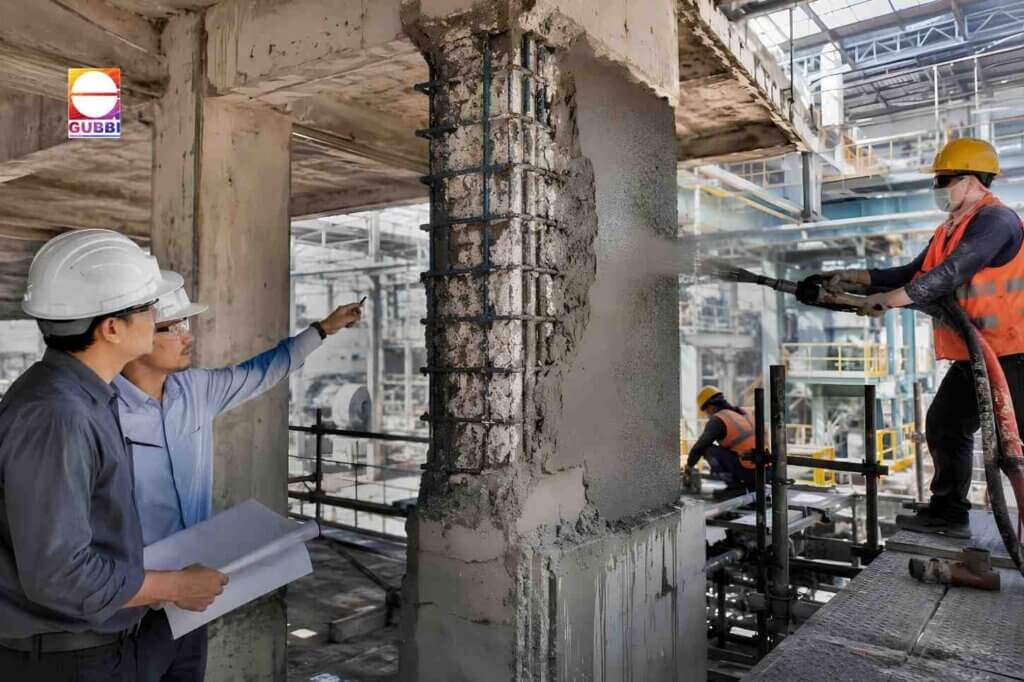
Structural Rehabilitation Techniques play a critical role in restoring, strengthening, and extending the service life of aging commercial and industrial buildings. As infrastructure assets are subjected to decades of operational loads, environmental exposure, chemical attack, moisture ingress, and changing functional requirements, structural deterioration becomes increasingly common. Issues such as concrete degradation, reinforcement corrosion, cracking, excessive deflection, and reduced load-carrying capacity can significantly impact structural safety and operational reliability.
For many facility owners and asset managers, complete demolition and reconstruction are neither economically feasible nor operationally practical. This is where engineered rehabilitation solutions provide a cost-effective and technically sound alternative. By utilizing appropriate structural rehabilitation techniques, deteriorated structural elements can be repaired, strengthened, and upgraded to meet current performance and safety requirements while minimizing disruption to ongoing operations.
The effectiveness of any rehabilitation program depends on a thorough structural assessment, detailed engineering analysis, accurate diagnosis of deterioration mechanisms, and the selection of rehabilitation methods best suited to the structure’s condition, service environment, and future operational demands. When implemented correctly, structural rehabilitation not only restores structural integrity but also improves durability, enhances performance, and protects valuable infrastructure investments for years to come.
Understanding Structural Deterioration in Commercial and Industrial Buildings
Unlike residential structures, commercial and industrial facilities are often subjected to aggressive service conditions that accelerate structural deterioration.
Common causes of structural deterioration include:
- Reinforcement corrosion due to moisture and chloride ingress
- Carbonation-induced concrete degradation
- Increased operational loads beyond original design capacity
- Chemical exposure in industrial environments
- Foundation settlement and differential movement
- Structural modifications without engineering evaluation
- Fire damage and thermal stress
- Seismic vulnerabilities in older structures
- Poor construction quality or inadequate maintenance
As deterioration progresses, structural members gradually lose their ability to perform as intended, increasing safety risks and maintenance costs.
Timely intervention through engineered rehabilitation measures helps prevent further damage while preserving valuable infrastructure assets.
Engineering Assessment: The Foundation of Effective Rehabilitation
Before selecting any rehabilitation technique, a comprehensive structural investigation must be conducted.
Professional structural assessment typically includes:
Visual Condition Survey
Engineers identify:
- Cracks and crack patterns
- Concrete spalling
- Rust staining
- Delamination
- Structural deformation
- Water leakage pathways
Non-Destructive Testing (NDT)
Advanced testing methods help determine actual structural condition, including:
- Rebound Hammer Testing
- Ultrasonic Pulse Velocity Testing
- Half-Cell Potential Testing
- Cover Meter Surveys
- Core Extraction and Compressive Strength Testing
Structural Analysis
Detailed analysis evaluates:
- Existing load-carrying capacity
- Stress distribution
- Deflection behavior
- Serviceability performance
- Future load requirements
Only after these investigations can the most suitable rehabilitation strategy be determined.
Key Structural Rehabilitation Techniques Used in Commercial and Industrial Buildings
1. Concrete Repair and Section Restoration
Concrete deterioration is one of the most common issues encountered in aging RCC structures.
When concrete becomes cracked, delaminated, or spalled, damaged portions are removed and reconstructed using high-performance repair mortars or micro-concrete systems.
Concrete Repair and Section restoration helps:
- Reinstate original member dimensions
- Protect reinforcement from further exposure
- Restore structural continuity
- Improve durability
Concrete Repair and Section restoration technique is widely used for:
- Columns
- Beams
- Slabs
- Water tanks
- Industrial structures
- Parking facilities
2. Guniting and Shotcreting for Structural Strengthening
Where extensive surface deterioration or strengthening is required, guniting and shotcreting provide highly effective rehabilitation solutions.
The process involves pneumatically projecting cementitious material at high velocity onto prepared structural surfaces.
Guniting key advantages include:
- Excellent bond strength
- Dense and durable concrete formation
- Reduced permeability
- Enhanced structural capacity
- Suitability for vertical and overhead applications
Typical applications of guniting include:
- Industrial chimneys
- Retaining walls
- RCC beams and columns
- Reservoirs
- Bridge components
- Coastal structures
Shotcreting is particularly effective where conventional formwork installation is difficult or impractical.
3. Reinforcement Corrosion Treatment
Corrosion remains one of the leading causes of structural degradation in commercial and industrial buildings.
Effective rehabilitation requires:
- Removal of contaminated concrete
- Mechanical cleaning of reinforcement
- Corrosion inhibitor application
- Protective coating systems
- Restoration using compatible repair materials
Addressing corrosion at its source significantly improves long-term structural performance and reduces recurring maintenance requirements.
4. Structural Jacketing Techniques
When structural members require increased load-carrying capacity, jacketing is commonly employed.
RCC Jacketing
Additional reinforced concrete is added around existing structural members to increase:
- Axial strength
- Flexural capacity
- Shear resistance
- Structural stiffness
Steel Jacketing
Steel plates or sections are installed around existing members to improve strength while minimizing dimensional changes.
Jacketing is frequently used in:
- Industrial buildings
- Warehouses
- Manufacturing facilities
- Commercial complexes
- Seismic retrofitting projects
5. Carbon Fiber Reinforced Polymer (CFRP) Strengthening
Modern rehabilitation projects increasingly utilize CFRP systems for structural upgrading.
Carbon fiber composites provide:
- High tensile strength
- Lightweight installation
- Corrosion resistance
- Minimal structural dead load addition
- Rapid execution
Common strengthening applications include:
- Beam flexural strengthening
- Shear enhancement
- Slab strengthening
- Column confinement
- Seismic upgrades
CFRP solutions are particularly advantageous where operational downtime must be minimized.
6. Structural Crack Repair Systems
Not all cracks indicate structural failure, but understanding their cause is essential.
Depending on crack characteristics, Structural Rehabilitation may involve:
- Epoxy injection
- Polyurethane injection
- Routing and sealing
- Flexible crack treatment systems
Proper crack repair restores structural continuity while preventing moisture ingress and reinforcement deterioration.
7. Foundation Rehabilitation and Underpinning
Foundation-related distress can significantly affect overall structural stability.
Indicators often include:
- Differential settlement
- Structural tilting
- Persistent cracking
- Floor unevenness
Rehabilitation methods may include:
- Underpinning systems
- Micro-piles
- Pressure grouting
- Soil stabilization techniques
These solutions help restore foundation performance without requiring complete reconstruction.
8. Seismic Retrofitting and Structural Upgrading
Many existing commercial and industrial buildings were designed according to older seismic standards.
Structural rehabilitation can improve earthquake resistance through:
- RCC shear walls
- Steel bracing systems
- Column strengthening
- Beam-column joint enhancement
- Foundation strengthening
Seismic retrofitting improves structural resilience while helping facilities meet updated safety requirements.
Selecting the Right Rehabilitation Technique
No single rehabilitation technique is suitable for every structure.
The selection process depends on:
- Structural condition
- Nature of deterioration
- Load requirements
- Environmental exposure
- Operational constraints
- Remaining service life objectives
- Budget considerations
An integrated rehabilitation strategy often combines multiple techniques to achieve optimal structural performance and long-term durability.
Benefits of Professional Structural Rehabilitation
Well-executed rehabilitation programs deliver significant advantages:
- Extended structural service life
- Improved safety and reliability
- Enhanced load-carrying capacity
- Reduced lifecycle maintenance costs
- Protection against future deterioration
- Compliance with updated standards
- Preservation of existing assets
- Reduced disruption compared to reconstruction
For industrial and commercial facilities, rehabilitation frequently offers a more cost-effective and sustainable alternative to replacement.
Conclusion
Commercial and industrial buildings represent significant operational and financial investments, making structural reliability a critical concern for owners, facility managers, and infrastructure stakeholders. As structures age and service demands evolve, timely intervention through professionally engineered structural rehabilitation techniques can prevent further deterioration, restore load-carrying capacity, and significantly extend asset service life.
From concrete repair and corrosion mitigation to structural strengthening, jacketing, shotcreting, and seismic retrofitting, the right structural rehabilitation strategy is always driven by thorough structural assessment and engineering analysis. When executed correctly, rehabilitation not only improves safety and durability but also reduces long-term maintenance costs and avoids the substantial expense of complete reconstruction.
If your commercial building, industrial facility, warehouse, plant structure, water-retaining structure, or RCC asset is showing signs of deterioration, cracking, corrosion, or reduced structural performance, early engineering intervention can help prevent costly future damage.
Gubbi Civil Engineers Ltd. provides comprehensive structural investigation, condition assessment, repair design, structural strengthening, shotcreting, guniting, jacketing, and rehabilitation solutions for aging concrete and RCC structures across diverse sectors.