
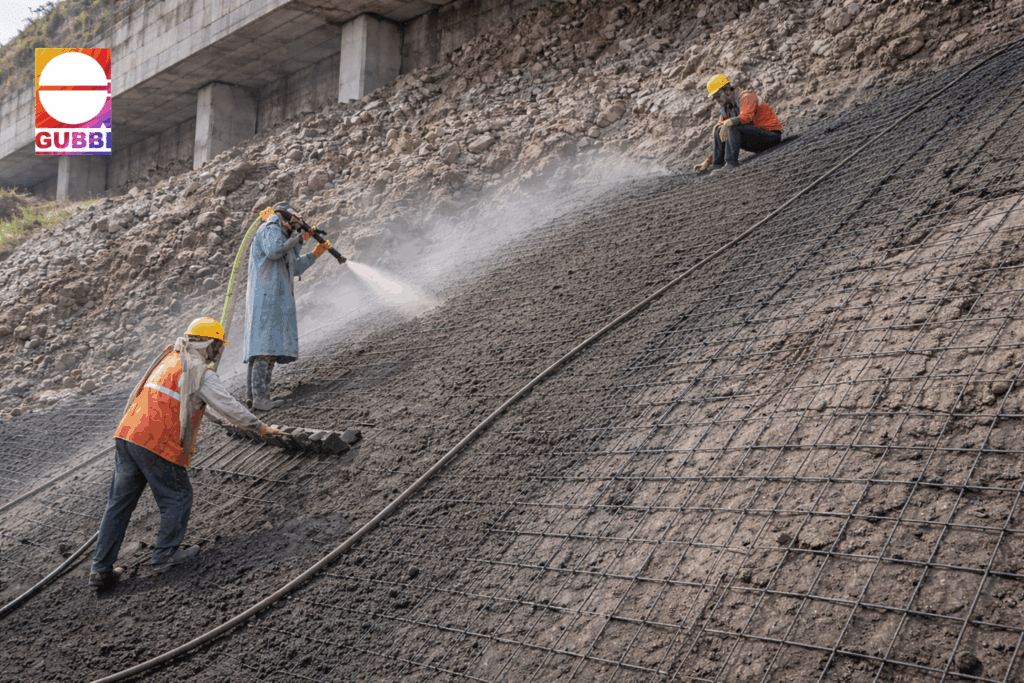
Structural deterioration is a major challenge in aging infrastructure and industrial buildings. Damage caused by corrosion, environmental exposure, overloading, and poor construction practices can significantly reduce the strength and durability of reinforced concrete structures. Shotcreting technology has emerged as one of the most effective solutions for structural repair and rehabilitation due to its high bonding strength, rapid application, and adaptability to complex surfaces.
Our blog explores shotcreting technology, its process, advantages, and applications in structural repair, helping engineers and contractors extend the service life of damaged structures.
What is Shotcreting Technology?
Shotcreting is a construction technique in which concrete or mortar is pneumatically sprayed at high velocity onto a surface using specialized equipment. The process ensures strong compaction and bonding with the existing substrate, making it highly effective for repair works.
Unlike conventional concrete placement, shotcrete does not require extensive formwork. The material is sprayed directly onto the prepared surface, forming a dense and durable layer of concrete.
Shotcrete is commonly used for:
- Structural strengthening
- Concrete repair
- Tunnel linings
- Retaining walls
- Bridge rehabilitation
- Industrial structure repair
The technique is widely adopted in modern infrastructure rehabilitation projects because it provides high structural integrity and improved durability.
Types of Shotcreting Methods
Shotcreting technology is mainly classified into two methods:
1. Dry-Mix Shotcreting
In the dry-mix process, cement and aggregates are mixed dry and conveyed through a hose. Water is added at the nozzle during spraying.
Advantages of Dry-Mix Shotcreting:
- Better control of water content
- Suitable for small repair areas
- Reduced equipment complexity
2. Wet-Mix Shotcreting
In the wet-mix process, concrete is premixed with water before pumping through the hose and sprayed using compressed air.
Advantages of Wet-Mix Shotcreting:
- Higher production rate
- Reduced dust generation
- Better quality control
Both methods are widely used in structural rehabilitation and repair projects depending on site requirements.
Importance of Shotcreting in Structural Repair
Structural repair projects require techniques that ensure strong adhesion between new and existing concrete. Shotcreting provides excellent bonding strength due to the high velocity of concrete particles striking the surface.
When applied to properly prepared surfaces, shotcrete can achieve strong bond strength with the substrate, often exceeding traditional cast-in-place repair methods.
This makes shotcreting highly suitable for repairing:
- Damaged RCC beams
- Corroded columns
- Spalled concrete surfaces
- Tunnel linings
- Bridge structures
Advantages of Shotcreting Technology
Shotcreting has gained popularity in structural rehabilitation because of its numerous advantages.
1. High Bond Strength
Shotcrete provides excellent adhesion to existing concrete, steel, and masonry surfaces, ensuring long-term durability of repairs.
2. Minimal Formwork Requirement
One of the biggest benefits is the reduction or elimination of formwork, which significantly reduces construction cost and time.
3. Faster Construction
Shotcreting allows rapid placement of concrete, enabling faster repair of structural components and reducing downtime in industrial facilities.
4. Suitable for Complex Shapes
Shotcrete can easily adapt to irregular surfaces, curved structures, and overhead repairs, making it ideal for rehabilitation works.
5. High Strength and Durability
Modern shotcrete mixes can achieve compressive strengths of 8000 psi or more, ensuring strong and durable repairs.
6. Cost-Effective Repair Solution
By reducing labor, formwork, and equipment needs, shotcreting becomes a cost-effective solution for structural restoration projects.
Applications of Shotcreting in Structural Rehabilitation
Shotcreting technology is widely used in civil engineering repair and strengthening projects.
1. Repair of RCC Structures
Shotcrete is used to restore damaged beams, columns, slabs, and walls in buildings affected by corrosion or deterioration.
2. Bridge and Infrastructure Rehabilitation
It is commonly used in repairing bridge decks, retaining walls, and culverts because it can be applied efficiently on vertical and overhead surfaces.
3. Tunnel and Underground Structures
Shotcrete provides structural support and lining in tunnels, mines, and underground construction projects.
4. Industrial Structures
Chemical plants, power plants, and industrial buildings use shotcrete to repair concrete exposed to harsh environments.
5. Structural Strengthening
Shotcreting can increase the thickness of structural members, improving their load carrying capacity and overall stability.
Shotcreting Process for Structural Repair
The typical shotcreting repair procedure involves several steps:
- Surface Preparation
- Removal of loose or deteriorated concrete
- Cleaning and roughening of the substrate
- Reinforcement Installation
- Fixing steel mesh or reinforcement bars if required
- Fixing steel mesh or reinforcement bars if required
- Application of Shotcrete
- Concrete sprayed using compressed air at high velocity
- Concrete sprayed using compressed air at high velocity
- Finishing
- Surface finishing and shaping
- Surface finishing and shaping
- Curing
- Proper curing to ensure strength development and durability
Proper preparation and skilled application are essential to achieve high-quality shotcrete repairs.
Shotcrete vs Conventional Concrete Repair
Aspect | Shotcrete | Conventional Concrete |
Formwork | Minimal or none | Extensive |
Application Speed | Faster | Slower |
Bond Strength | Very High | Moderate |
Suitable Surfaces | Vertical, overhead, curved | Mostly horizontal |
Cost | Cost-effective in repairs | Higher in complex repairs |
This comparison highlights why shotcreting is increasingly preferred for structural rehabilitation.
Future of Shotcreting Technology
Advancements in polymer-modified shotcrete, fiber-reinforced mixes, and robotic shotcrete equipment are further improving the performance and efficiency of this technology.
Modern innovations focus on:
- Enhanced durability
- Reduced rebound loss
- Improved automation
- Sustainable construction practices
These developments make shotcreting one of the most promising techniques in modern structural repair engineering.
Shotcreting technology has revolutionized the field of structural repair and retrofitting. Its ability to provide strong bonding, rapid application, and high durability makes it an ideal solution for restoring damaged concrete structures.
From bridges and tunnels to industrial buildings and RCC structures, shotcreting ensures long-lasting repairs and improved structural performance.
As construction technology advances, shotcreting will continue to play a vital role in extending the service life of critical infrastructure.